
Key Points:
- ABA therapy helps children with autism learn and practice social skills in structured, repeatable ways, which strengthens their confidence over time.
- Through targeted methods such as role-playing, natural environment training, and positive reinforcement, children become more comfortable in social interactions and less anxious in peer settings.
- Parents and caregivers play a vital role in generalising those skills from therapy into everyday life; consistent reinforcement at home or school helps cement confidence gains.
- Behavior therapy for children with autism isn’t just about reducing challenging behaviors; it’s also about increasing engagement, communication, and social participation.
- For families seeking ABA therapy for kids, access to local providers (e.g., “ABA therapist near me” or “ABA Therapy near me”) and services offering tailored social skills ABA programs matter.
Watching your child struggle in social situations like not looking others in the eye, not knowing how to start a play with a peer, and feeling isolated at school can be heartbreaking. As a parent or caregiver, you want your child to feel comfortable, connected, and confident. This is where therapeutic support can make a meaningful difference.
One intervention that has helped many children on the autism spectrum is Applied Behavior Analysis (ABA) therapy. In particular, this article examines how ABA therapy builds social confidence, helping children feel both capable and willing to engage with others. We’ll explore what social confidence really means, how ABA supports it step by step, what parents and caregivers can do, and how to look for the right provider (for example, if you’re searching for “ABA therapy in Maryland” or “ABA therapist near me”).
By the end, you’ll have a clear understanding of how ABA can be a practical route toward stronger social skills, and concrete ideas you can bring home to support your child’s growth.

Why Social Skills Matter in ABA Therapy
When we talk about “social skills ABA”, we refer to the component of ABA therapy that focuses on social interactions like turn-taking, sharing, greetings, joint attention, initiating requests, responding to peers. ABA-based interventions can lead to improvements in socialization and communication skills.
Why is this important? Because as children get better at social skills, they are more likely to engage with classmates, make friends, feel less anxious during group activities, and build a cycle of participation and success rather than withdrawal. In short, social confidence grows when the child has both the ability and motivation to engage.
How ABA Therapy Builds Social Confidence
Here, we walk through how ABA therapy works step by step to build social confidence in children.
1. Individualised assessment and goal-setting
Before any social skills work begins, an ABA therapist will assess the child’s current social strengths and challenges: Can the child initiate with others? Sustain back-and-forth interaction? Read non-verbal cues? Participate in peer play? Based on that, measurable goals are set. This ensures the work is tailored, not one-size-fits-all.
With child-specific goals, small wins become visible. For example: “Ask a peer for a turn with a toy”, or “Respond to a greeting without prompt”. When children achieve these micro-goals, they experience success, and that builds confidence.
2. Structured learning of social behaviors
One of the hallmarks of ABA therapy is breaking down complex behaviors into manageable steps. Techniques such as Discrete Trial Training (DTT) and Natural Environment Training (NET) are commonly used. In social confidence work:
- DTT might involve practicing greetings, then initiation, then maintaining a short conversation.
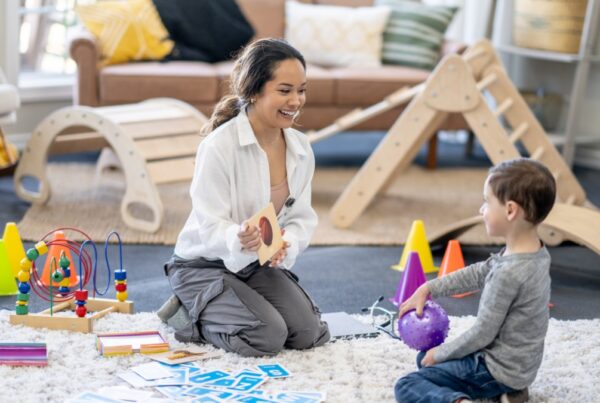
- Role-playing and modelling are used: the therapist demonstrates an interaction and the child practices it in a controlled environment.
- Natural environment training moves the child into more realistic settings (playground, classroom, lunch table) so they apply the skills in actual context.
By gradually increasing complexity, the child builds not only competence but expectation of success, which is one of the ingredients of confidence.
3. Positive reinforcement and feedback
Whenever the child demonstrates a targeted behavior (for example, making eye contact, asking a peer a question, using appropriate body language), positive reinforcement is used: verbal praise, tokens, and preferred activities. This helps to cement the behavior, but also sends a message: “I did something, I was successful, and good things happen.”
This reinforcement builds motivation and self‐efficacy. Research indicates that children in ABA show improvements in social skills and self‐esteem.
4. Generalisation and real-world practice
A key challenge in social skills work is that behaviors learned in therapy might not automatically transfer to natural settings. The difference between “I can do this in therapy” vs “I’ll do this at recess” is significant. ABA programs that emphasise generalization help bridge that gap.
For example, after role-playing a peer-request in therapy, the child is coached to try that request during a real peer play session, with therapist support fading over time. Through repeated success in real contexts, social confidence increases. One article noted that children through ABA interaction had improved peer relationships when collaborative activities were used.
5. Reducing social anxiety and increasing comfort
For children who are shy or anxious in social situations, building confidence involves managing emotional states. ABA therapy contributes by providing structured practice, predictable contexts, role-play of feared or avoided scenarios, and gradually increasing exposure to social interactions.
When a child experiences fewer failures and more successes in social interactions, their anxiety often decreases; they feel more comfortable initiating, waiting, sharing, and that reduced anxiety itself boosts confidence.
6. Incorporating parents and caregivers
The work doesn’t end in the therapy room. For social confidence to grow, children need the opportunity to practice at home, school, or community settings. Parents/caregivers are often coached in strategies such as prompting, praising, arranging peer opportunities, and reinforcing newly learned skills. When these home supports are aligned, children get more practice and their gains carry over, which strengthens confidence.
Practical Tips for Parents and Caregivers
Here are some actionable ideas you can implement alongside ABA therapy to help build your child’s social confidence.
Daily opportunities for social practice
- Arrange short, low-pressure playdates or shared-play times with one peer.
- Set up simple tasks: “Would you like to ask Jamie if he wants to share the ball?”
- Encourage your child to greet people in safe contexts (neighbourhood, family friend) and praise the attempt.
Reinforce successes
- After your child tries a social interaction (even imperfectly), highlight what went well: “You asked Jamie a question, that’s great!”
- Use consistent praise (verbal, hug, high-five, sticker) so your child connects the positive social behavior with rewards.
- Avoid focusing solely on mistakes; over time, celebrate progress, not perfection.
Collaborate with your child’s ABA team
- Ask the therapist about specific social goals your child is working on.
- Request home-practice ideas aligned with the therapy session so you’re supporting the same skills.
- Share your child’s successes (or struggles) with the therapist so sessions can adjust accordingly.
Safe environments for practice
- Provide predictable routines: before a playdate, talk about what will happen (“First we’ll say hello, then we’ll share a toy, then we’ll play hide-and-seek”).
- Role-play scenarios beforehand if your child is anxious about new settings.
- Encourage your child to reflect afterward: “You asked Sam if he wanted the blue car. How did that feel?”
Encourage social initiative gradually
- Start with structured, shorter interactions and then expand to less-structured ones (free play, group settings).
- Support your child in waiting for turn, asking for help, and then fading prompts so the child can take more initiative over time.
- When your child is comfortable, include new peers, new settings, and different contexts to broaden their confidence.
Monitor and adapt
- Keep a simple log: what social interaction happened, how your child responded, whether it was easy or hard.
- Note anxiety or avoidance behaviors and discuss them with your child’s therapist to adjust goals/templates.
- Recognize that progress may be gradual; small steps accumulate over time.
Common Challenges and How ABA Therapy Helps Address Them
Challenge: Child avoids social interaction
This may be due to past failed attempts, anxiety or difficulty interpreting social cues. ABA therapy helps by creating safe practice zones, breaking tasks into small steps, and slowly increasing exposure. When the child experiences success, avoidance reduces, and opportunity to engage rises.
Challenge: The Child can say words but doesn’t initiate or maintain interaction
Knowing what to say and spontaneously using it are two different things. ABA uses role-play, modelling, and natural environment practice to push from prompted to spontaneous initiation: “Hi, can I …?”, “Would you like to play?” Over time, initiation becomes more comfortable.
Challenge: Social skills exist in therapy but not at home/school
Generalization is always a hurdle. The ABA therapist will plan for natural environment training and embed skills into real-life settings. Parents and teachers being on board helps transfer those skills. Without this bridge, confidence might remain limited to the therapy room.
Challenge: Child becomes anxious in group or peer contexts
ABA therapists can design gradual exposure to peer settings, provide scaffolding, role-play feared situations, and build mastery before full participation. Each successful step reduces the anxiety-avoidance cycle, increasing comfort and confidence.
Challenge: Hard to find skilled local provider
As you research “ABA therapist near me” or “ABA Therapy near me”, check for clinicians experienced in social skills interventions, not just behavior reduction. Ask about their track record in social skills ABA and how they involve families. The right match can make a real difference in building social confidence.
Choosing the Right ABA Program for Social Confidence
When seeking ABA therapy, especially for social confidence, consider the following checklist:
- Does the provider list social skills training as a clear component of their program (not just behavior reduction)?
- Are the goals measurable and specific (e.g., “Initiates peer play twice per week”)?
- Does the program include natural-environment practice (playground, lunch table, community) and generalization across settings?
- Are parents/caregivers included in training, home-practice and follow-through?
- If you’re looking in your region (for example, searching for “ABA therapy in Maryland”), confirm the provider’s local presence, reputation, and ability to coordinate with school or community settings.
- Ask about reinforcement methods: how successes are rewarded, how they introduce new social tasks, and how progress is tracked.
- Ensure the therapist is qualified (e.g., Board Certified Behavior Analyst or equivalent) and experienced in autism-specific social skill interventions.
Selecting the right provider influences how confidently your child can move from “in therapy” to “in life”.
When Should You Start and What Should You Expect?
Starting as early as possible tends to yield better outcomes, especially when skills are still developing. Early engagement in ABA therapy for kids can lead to gains in communication, adaptive behaviors and social participation.
That said, building social confidence is not an overnight process. Here’s a reasonable expectation timeline:
- Short term (weeks to months): Child begins practising basic social behaviors in therapy, sees small successes, begins positive reinforcement.
- Mid term (6-12 months): Child starts to apply taught skills in more natural settings (home, preschool, playdate), less prompt support required, hesitancy decreases.
- Long term (12+ months): Child initiates more independently, maintains sustained interactions, engages with peers with greater comfort, and carries over skills across contexts.
It’s helpful to view therapy as laying a foundation and gradually increasing real-life social confidence, rather than expecting instant mastery.

A Confident Tomorrow
When you invest in social skills ABA, choosing a program where a child practicing in therapy gradually becomes a child confidently interacting in life, you are investing in more than just a skill set. You’re helping your child build the confidence to connect, to engage, and to belong.
Exploring behavior therapy for children and looking for services that emphasize not only behavior reduction but also social growth? It’s worth asking providers how they build social confidence, how they partner with families, and how they take the skills from therapy into real settings. Because, ultimately, social confidence is about feeling capable, comfortable, and connected.
Take the next step toward building your child’s social confidence through ABA therapy. If you’re searching for “ABA Therapy near me” or “ABA therapy in Maryland”, consider reaching out to Crown ABA. They offer tailored programs for children with autism, emphasizing social skills, peer interaction, and family involvement, serving the Maryland community with dedicated behavior therapy for children, and are committed to helping each child gain the confidence to engage and thrive.
Contact Crown ABA today to discuss how we can support your child’s journey toward stronger social connections and self-assurance.